Tokenization
Written by

Theo Blake- Expert in Wealth Strategist | Investment Fund Management
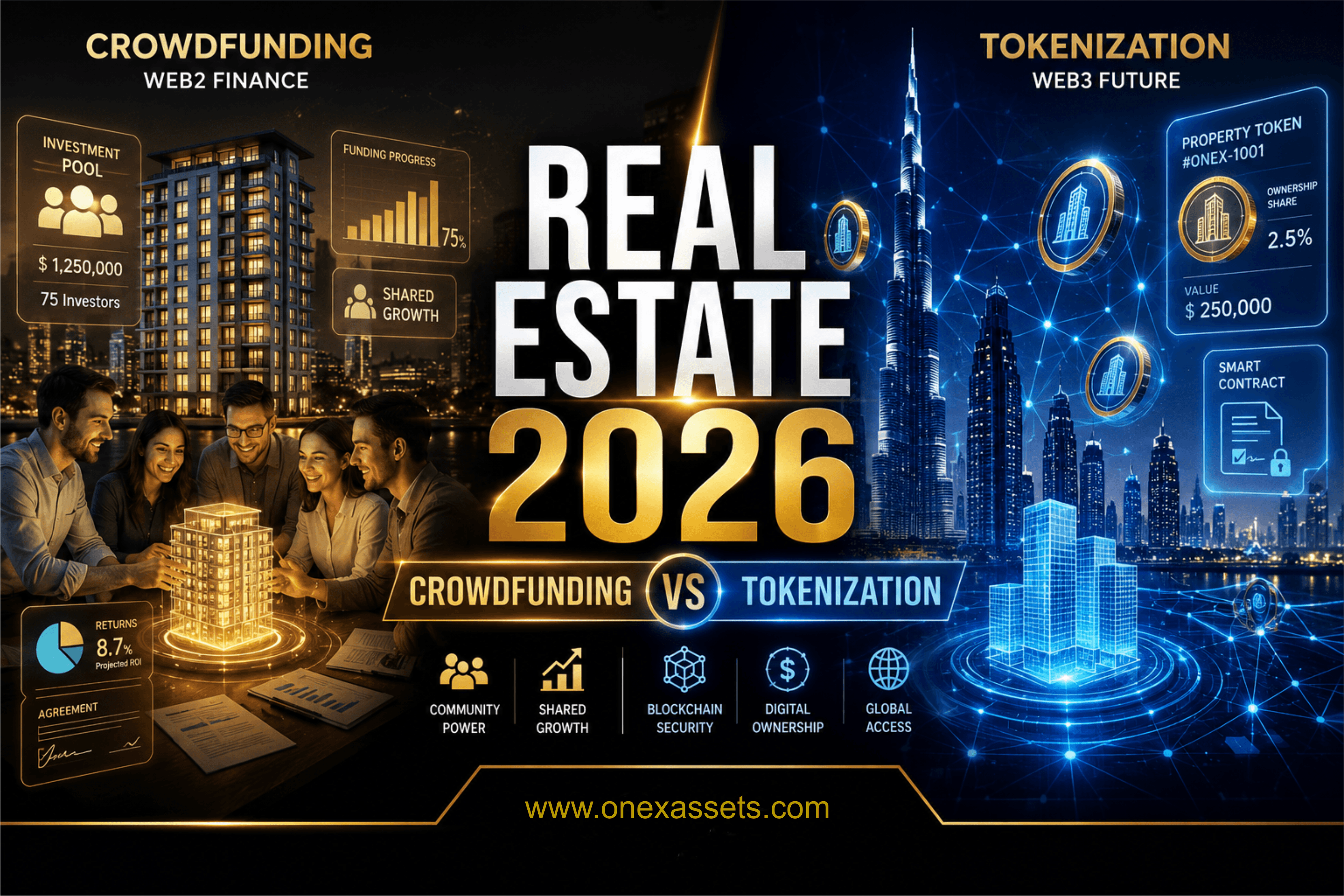
The global real estate industry is undergoing one of its biggest transformations in decades. Traditional property investing—once limited to high-net-worth individuals and institutional funds—is now ONEX Assets being reshaped by two powerful models: real estate crowdfunding and blockchain-based tokenization.
In fast-moving financial hubs like Dubai and the wider UAE, this shift is not theoretical anymore. It is already happening. With progressive regulation, digital infrastructure, and investor-friendly policies, the region is becoming a global testing ground for the future of property ownership.
For today’s investors, developers, and asset managers, the real question is no longer if this transformation will happen—but how to participate in it strategically.
1. Crowdfunding vs. Tokenization: Understanding the Core Difference
At first glance, both crowdfunding and tokenization aim to solve the same problem: making real estate investment more accessible through fractional ownership. But beneath that similarity, they are fundamentally different systems.
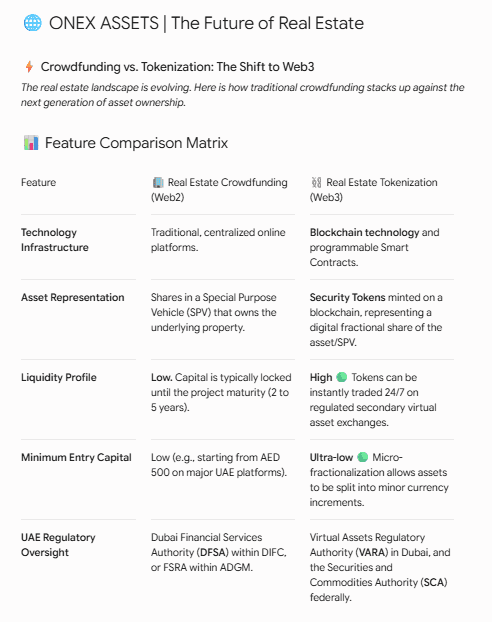
Real estate crowdfunding : works like a digitally enabled investment pool. Investors collectively fund a property or development through a regulated platform, usually structured under traditional legal frameworks such as SPVs (Special Purpose Vehicles).
Tokenization: on the other hand, takes this a step further. It converts real estate ownership into digital tokens on a blockchain, where each token represents a verifiable share of the underlying asset. These tokens can potentially be traded, transferred, or held much like digital securities.
In simple terms:
Crowdfunding digitizes access to real estate investment
Tokenization digitizes ownership itself
2. How Investment Strategies Change in a Digital Real Estate World
Different investors have different goals—some prioritize steady rental income, others look for short-term gains, while some focus on commercial-scale opportunities. Both crowdfunding and tokenization serve these strategies differently.
1. Buy and Hold (Rental Income Strategy)
This is the most traditional and stable investment approach: buy a property, earn rental income, and benefit from long-term appreciation.
Through Crowdfunding
Platforms operating in regulated environments like Dubai allow investors to own fractional shares of completed, income-generating properties. The platform manages tenants, maintenance, and rent collection, while investors receive regular income distributions.
It is simple, predictable, and ideal for investors seeking stability.
Through Tokenization
Tokenization introduces a new layer of flexibility. Rental income can be distributed automatically through smart contracts directly to digital wallets, often in stable digital currencies.
More importantly, investors are no longer locked in. If liquidity is needed, they can sell a portion of their tokens instead of exiting the entire investment. This makes real estate more dynamic and flexible than ever before.
2. House Flipping / Value-Add Strategy
This strategy focuses on short-term gains—buying early, improving value, and selling at a higher price.
Through Crowdfunding
Investors typically participate in structured development or renovation projects. Funds are pooled, the project is executed, and returns are distributed once the asset is sold. The investment cycle is usually 12–24 months.
It is structured but relatively illiquid.
Through Tokenization
Tokenization significantly improves speed and flexibility. Investors can enter during early construction phases and exit gradually as the project value increases.
Because transactions happen digitally, ownership transfer becomes faster and less dependent on traditional paperwork and administrative delays. This creates a much more efficient capital flow.
3. Commercial Real Estate (CRE) Strategy
Commercial assets such as hotels, office towers, and logistics hubs have traditionally been reserved for institutional investors due to high entry costs.
Both crowdfunding and tokenization are changing this.
Crowdfunding allows smaller investors to access large commercial portfolios through pooled capital.
Tokenization, however, goes further by enabling global investors to participate in high-value assets with instant settlement, fractional ownership, and programmable yield distribution. This opens the door to truly global commercial real estate syndication.
4. Why ONEX Assets Tokenized Real Estate is Gaining Momentum
The advantages are becoming increasingly clear:
Liquidity: Real estate becomes easier to buy and sell, reducing long lock-in periods.
Automation: Rental income and distributions are handled digitally and transparently.
Lower Friction: Reduced dependency on brokers, paperwork, and manual processes.
Global Access: Investors can participate from anywhere in the world.
Transparency: Blockchain records improve trust and reduce disputes.
This is not just innovation—it is a structural upgrade to how real estate works.
Conclusion: Which Model Fits the Future?
Both crowdfunding and tokenization have strong use cases, and neither is replacing the other completely.
Crowdfunding is ideal for investors who prefer simplicity, regulation, and predictable long-term returns.
Tokenization is designed for those who value liquidity, speed, and global accessibility.
In reality, the future of real estate will likely combine both systems, creating a hybrid investment ecosystem.
What is clear, however, is that the UAE—especially Dubai—is positioning itself at the center of this evolution, turning real estate into a truly global, digital asset class.
The ONEX Assets Perspective
At ONEX Assets, we believe the future of investing lies in bridging real-world assets with modern financial technology—without compromising transparency, regulation, or investor trust.
Our focus is simple:
To make alternative investments and real estate opportunities more accessible, understandable, and efficient for global investors.
Because in the coming decade, real estate will not only be defined by ownership.
It will be defined by how ownership is structured, verified, and shared across borders.
Disclaimer
This article is provided for informational and educational purposes only and should not be considered financial, investment, legal, or tax advice. Investment returns are not guaranteed, and all investments carry risk, including the potential loss of capital. OneX Virtual Assets LLC, Dubai, is not a registered broker-dealer or investment advisor. Investors should conduct their own due diligence and consult qualified professional advisors before making any investment decisions.